
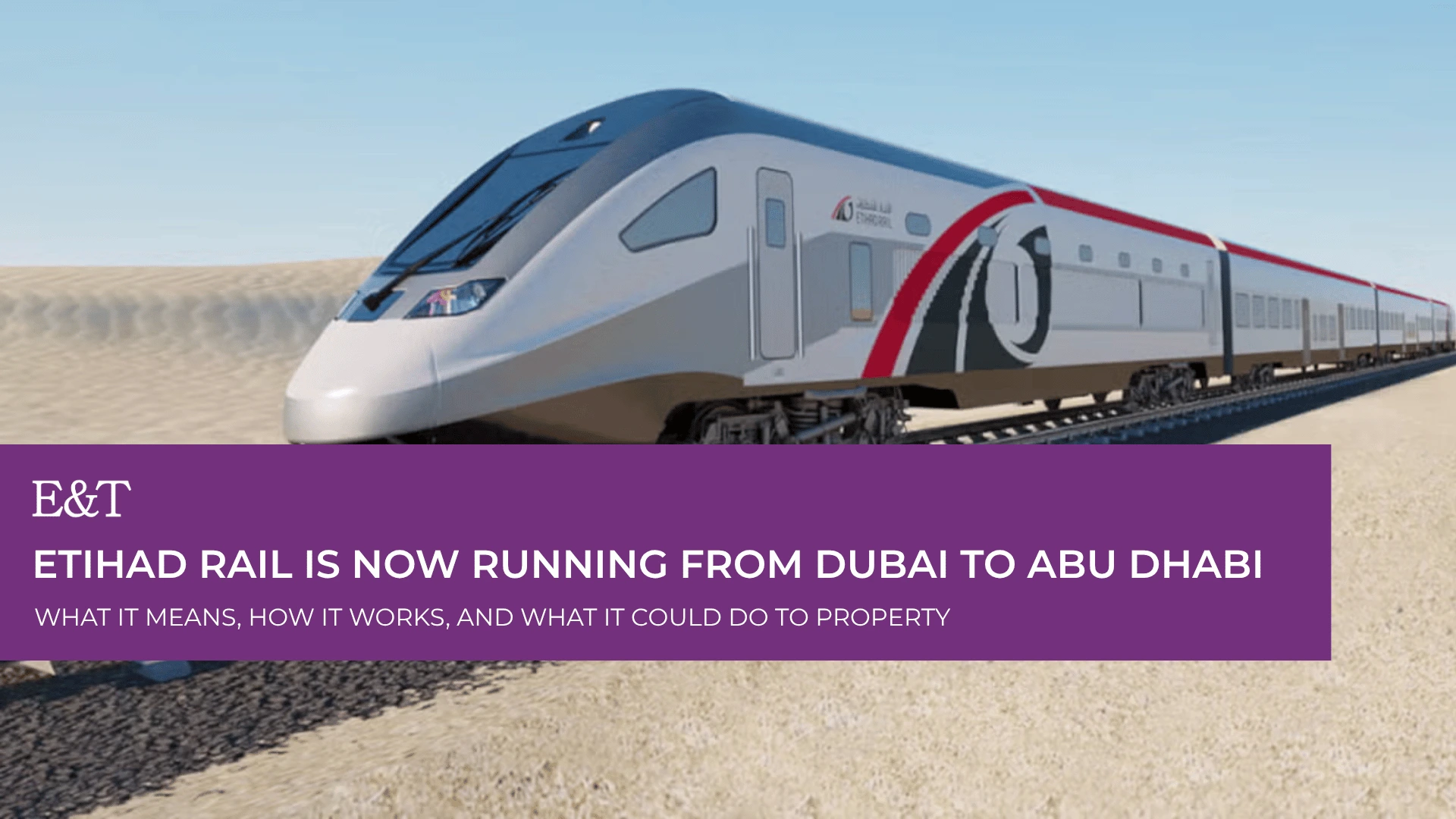

Etihad Rail Is Now Running from Dubai to Abu Dhabi: What It Means, How It Works, and What It Could Do to Property
Something genuinely historic happened on September 30, 2026. For the first time in the UAE’s history, a passenger train departed from Dubai and arrived in Abu Dhabi. The journey took 57 minutes. The ticket cost AED 39 in Comfort Class. And UAE President Sheikh Mohamed bin Zayed attended the Dubai station opening alongside Sheikh Hamdan bin Mohammed, Crown Prince of Dubai. That combination of detail tells you everything about how significant this moment is considered to be.
Etihad Rail has been in development for years, running freight across its 900-kilometre network since 2023. The passenger chapter is different. It is the infrastructure that reshapes how people live, where they choose to live, and what property near the network is actually worth. Here is everything you need to know.
How the Network Works Right Now
The Etihad Rail passenger network launched in two phases. The first route, connecting Abu Dhabi to Fujairah, opened on June 30, 2026, with a journey time of 1 hour and 45 minutes and six daily services in each direction. That route gave residents their first taste of intercity rail in the UAE and sold out quickly in its opening weeks.
On September 30, the network expanded decisively. Dubai’s Al Yalayis Station at Jumeirah Golf Estates opened, along with Al Dhaid Station in Sharjah, connecting the UAE’s three largest population centres by rail for the first time. Ten daily services now operate between Dubai and Abu Dhabi, five in each direction. The Dubai station connects directly to the Dubai Metro Red Line via an elevated pedestrian footbridge, meaning residents across the city can reach the station by metro and board a train to Abu Dhabi in a single journey with no need to drive or park.
Station Rollout: What Is Open and What Is Coming
| Station | Location | Status |
| Mohamed Bin Zayed City | Abu Dhabi | Open since June 30, 2026 |
| Fujairah | Madinat Al Hilal, Fujairah | Open since June 30, 2026 |
| Al Yalayis | Jumeirah Golf Estates, Dubai | Open since September 30, 2026 |
| Al Dhaid | Sharjah | Open since September 30, 2026 |
| Al Sila | Al Dhafra, Abu Dhabi | December 30, 2026 |
| Al Dhannah | Al Dhafra, Abu Dhabi | December 30, 2026 |
| Al Mirfa | Al Dhafra, Abu Dhabi | December 30, 2026 |
| Madinat Zayed | Al Dhafra, Abu Dhabi | November 30, 2026 |
| Sharjah University City | Sharjah | March 30, 2027 |
Source: Etihad Rail official station data and Arabian Business, October 2026. Verify current timetables and station opening dates at etihadrail.ae before travel.
Journey Times and Ticket Prices
The Abu Dhabi to Dubai journey officially takes 57 minutes, against a typical car journey of between 60 and 90 minutes depending on traffic, and against a journey that can stretch to two hours or more during peak hours. On a daily commute basis, the difference between a predictable 57-minute train journey and an unpredictable 90-minute drive is not trivial. It is the difference between two hours of commuting time per day and slightly under two hours, five days a week, which over a working year represents a meaningful recovery of personal time.
Tickets for the Abu Dhabi to Dubai route are priced from AED 39 in Comfort Class and AED 109 in Premium Class. The Abu Dhabi to Fujairah route is priced from AED 55 in Comfort Class and AED 120 in Premium Class. Tickets are available through the Etihad Rail app, the website at etihadrail.ae, and through ticket machines at stations. Each train carries up to 400 passengers across its three classes, with Economy, Comfort, and Premium offering different seating configurations and levels of service.
Etihad Rail Ticket Prices at a Glance
| Route | Comfort Class | Premium Class | Journey Time |
| Abu Dhabi to Dubai | AED 39 | AED 109 | 57 minutes |
| Abu Dhabi to Fujairah | AED 55 | AED 120 | 1 hour 45 minutes |
| Dubai to Fujairah | To be confirmed | To be confirmed | Approx. 2 hours |
| Abu Dhabi to Al Dhafra (Ruwais) | To be confirmed | To be confirmed | Approx. 70 minutes |
Source: Etihad Rail Mobility official pricing, September 2026. Verify current fares at etihadrail.ae before booking.
The Communities That Sit Closest to Al Yalayis
The Dubai station is named Al Yalayis and sits at Jumeirah Golf Estates in southern Dubai, adjacent to the existing Dubai Metro Red Line station at Jumeirah Golf Estates. The pedestrian footbridge connecting the two is already open, making this the first point in the UAE where national rail and urban metro networks physically intersect.
The communities within closest proximity to Al Yalayis Station include Jumeirah Golf Estates itself, Al Furjan, Dubai Investment Park, Green Community, Dubai Production City, Expo City Dubai, and Dubai South. For residents of these communities, particularly those who work in Abu Dhabi or travel there regularly, the station transforms what was a highway commute into a predictable, comfortable rail journey. For residents of any Dubai community connected to the Red Line, the same journey is now accessible by combining the metro with the train at Al Yalayis.
What This Means for Property: The Honest Read
The question every buyer and investor wants answered is what Etihad Rail will do to property values along the route. The honest answer is: it has already started, and the full effect will take several years to measure completely.
Properties near confirmed Etihad Rail station locations have risen approximately 13 percent in value over the past nine months, with Dubai South and Dubai Investment Park close behind at 17 percent, according to data from the period before the September 30 opening. Those figures reflect anticipation of the network rather than its operational reality, which means the price movement since announcement has already been meaningful. The question now is what the operational service adds on top of it.
The international precedent is instructive. London’s Crossrail, the Elizabeth Line, led to approximately 20 percent price increases near its stations following the green light being given for the project, according to analysis from multiple real estate advisors. Dubai has seen a consistent pattern from its own metro expansions: communities that gained Red Line and Green Line access consistently outperformed the broader market in the years following connectivity improvements. There is every reason to expect Etihad Rail to produce a similar effect, particularly in communities where the train makes previously difficult commutes manageable.
For Jumeirah Golf Estates specifically, the property impact is expected to be measured and gradual rather than dramatic, because the station’s existence has been known for some time and partially priced in. The more significant upside is likely to fall in the broader southern Dubai corridor, where Dubai South, Dubai Investment Park, and Expo City sit at the intersection of multiple infrastructure catalysts: Etihad Rail at Al Yalayis, the Metro Blue Line planned for the Al Maktoum Airport corridor, and the airport expansion itself.
For Abu Dhabi residents considering purchasing in Dubai, or for Dubai residents who work in Abu Dhabi, Etihad Rail changes the mathematics of the decision. A family that was previously deterred from buying in Dubai because of the daily Abu Dhabi commute now has a 57-minute predictable train journey as the alternative. The same calculation in reverse applies to Abu Dhabi buyers who want the Dubai lifestyle on weekends or who have family in the emirate. The rail connection widens the effective catchment of both property markets and creates a genuinely new category of cross-emirate buyer.
The Bigger Picture: What Comes Next
Etihad Rail is not finished. The Al Dhafra stations opening in December 2026 will extend the network into Abu Dhabi’s western corridor, adding connectivity to communities and industrial areas that are currently very difficult to reach without a car. Sharjah University City opens in March 2027, which will connect the emirate’s student and academic population to the network and create a new corridor of rental demand around that station.
The most significant future development for Dubai property specifically is the planned integration between Etihad Rail and the Metro Gold Line at Jumeirah Golf Estates. When the Gold Line opens in 2032, Al Yalayis will become a triple-interchange point: Etihad Rail, Metro Red Line, and Metro Gold Line all meeting at a single station. That configuration, which has no current equivalent in Dubai’s transport network, makes the surrounding area one of the most strategically connected residential corridors the city will have. Communities along the Gold Line that also have practical access to Etihad Rail, particularly Meydan, Business Bay, and Jumeirah Golf Estates itself, are expected to see the most sustained long-term connectivity premium of any location in Dubai.
The rail era in the UAE has begun. It started quietly on June 30 with a train to Fujairah. It became real for Dubai on September 30. And it is going to keep changing the map of where people want to live, what those locations are worth, and how the UAE’s cities connect to each other for the rest of this decade and well into the next.
If you want to understand how Etihad Rail affects the value of a property you own, a community you are considering buying in, or an investment you are evaluating in southern Dubai or along the Abu Dhabi corridor, our team is available for a private consultation.
Contact us at info@edwardsandtowers.com or visit edwardsandtowers.com.

