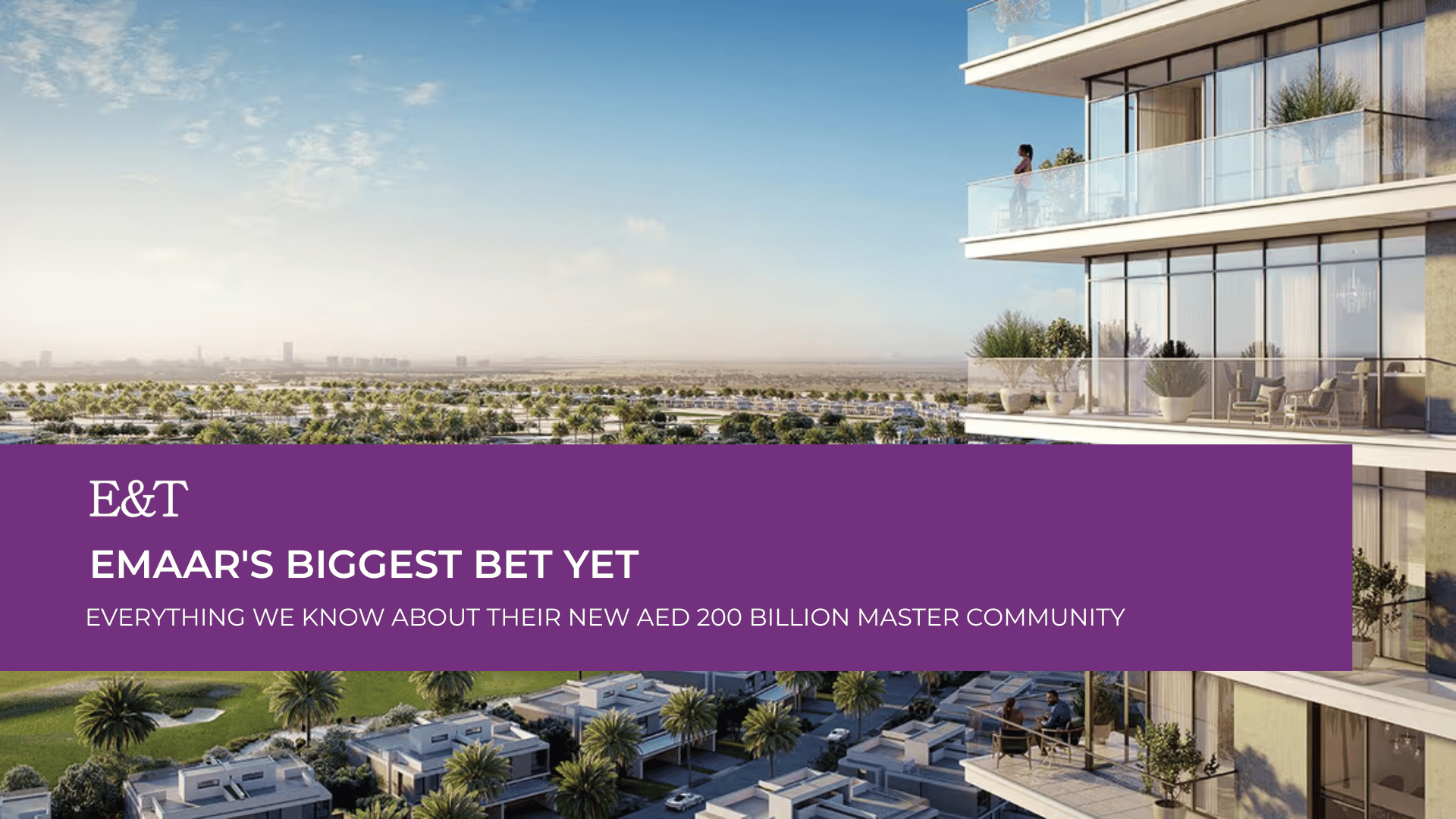

Emaar’s Biggest Bet Yet: Everything We Know About Their New AED 200 Billion Master Community
Emaar new masterplan Dubai 2026. Emaar AED 200 billion community. Emaar master community 2026. Dubai new development 150000 residents. Emaar Dubai investment 2026. Dubai off-plan masterplan.
Emaar built the Burj Khalifa. They built Downtown Dubai from a patch of desert. They created Dubai Hills Estate when nobody was quite sure what would go there. And now, in June 2026, they have announced something that makes all of it look like a warm-up act.
The numbers alone are worth sitting with for a moment. AED 200 billion. More than 4.5 million square metres of built-up area. A community designed for 150,000 residents. Five distinct character zones. Swimmable lagoons. Gold Line metro access. Views of the Burj Khalifa, Burj Al Arab, and Palm Jumeirah from the same address. This is Emaar’s newest master community, and while the full details are still being released, what we already know is considerable. Here is the full picture.
What It Actually Is
This is not a tower. It is not a cluster of towers. It is not even a neighbourhood in the conventional sense. Emaar is building a fully self-sustaining urban district, a place where someone could theoretically live their entire daily life without ever needing to leave. Work, school, healthcare, dining, retail, wellness, culture, green space, all within walking distance of wherever you happen to live within it.
The 20-minute city concept is the planning framework Emaar has applied throughout, meaning every essential daily function should be reachable within 20 minutes on foot or by soft mobility from any residential address in the community. Given that the Gold Line metro connection is proposed as part of the infrastructure, getting further afield will not require a car either.
At AED 200 billion, it is the largest single master community commitment ever made by a private developer in UAE history. That figure is not a projection or an aspiration. It is the confirmed development value behind the project, announced publicly by Emaar in June 2026.
The Five Zones, Explained
The masterplan is divided into five zones, each with its own personality and residential profile. Getting familiar with them now, before sales launches begin, is genuinely useful.
The Business Hub anchors the commercial core of the community. Grade A offices, business infrastructure, and the kind of corporate environment designed to attract international firms looking for a premium address. By integrating the workplace into the broader community rather than separating it, Emaar is essentially eliminating the commute for anyone who both lives and works within the development.
The Urban District is where the landmark residential towers sit. Think high-density, highly connected, highly amenitised apartment living for professionals, couples, and investors looking for strong rental demand potential. This is the zone most likely to attract the widest range of buyers globally.
The Young Families Cluster sits between the denser urban core and the quieter outer zones. It is designed for households who want convenience and community energy without the full intensity of high-rise living. Think mid-rise buildings, generous landscaping, and a neighbourhood feel that does not require sacrificing connectivity.
The Family Living Zone steps it down another gear. Lower density, more space, the kind of address where the school run takes three minutes and the park is across the road. This is the zone that will likely draw the strongest interest from residents planning to put down long-term roots rather than investors purely chasing yield.
The Exclusive Villa Enclave is exactly what it sounds like. A gated residential pocket of signature villas and luxury mansions at the premium outer edge of the masterplan, offering the privacy and scale of a standalone estate within the security and shared infrastructure of one of the most ambitious planned communities ever built in this city.
What the Place Will Actually Feel Like
Beyond the zone breakdown, the landscape and public realm detail that Emaar has released gives a sense of what daily life inside the community is designed to feel like.
Swimmable lagoons sit at the heart of the residential zones, alongside lakes, water streams, and linear gardens threaded through the community. Shaded promenades and dedicated cycling paths connect the different zones. A central district park will include sports courts, event lawns, splash parks, beach areas, and outdoor wellness facilities. And at street level, a grand boulevard with a high street spine will carry curated retail, dining, cafes, and cultural venues in the kind of animated ground-floor experience Emaar has perfected across Downtown Dubai and brought to Dubai Hills in a different format.
Smart infrastructure is built in from the start rather than added later. EV-friendly pathways, intelligent building systems, app-integrated community management, and data-driven public services are all part of the planning. The proposed Gold Line metro connection, if confirmed, would make this one of the most transport-connected new communities in the city from the day it opens.
The Views
This deserves its own mention because it is genuinely unusual. The development has been positioned so that residential towers and key public spaces will have direct sightlines to the Burj Khalifa, Burj Al Arab, and Palm Jumeirah simultaneously. Commanding views of one of those three is an address premium in Dubai. Having all three from the same community is something that very few locations in the city can offer.
What We Are Still Waiting On
Emaar has been deliberate about releasing information in stages, and there are several things that are not yet confirmed. The official project name has not been formally announced by Emaar at the time of writing. The precise location within Dubai, beyond the broad descriptor of the heart of the city, has not been disclosed. Unit counts per zone have not been released. Pricing across any property type has not been set. The phased launch timeline, which for a development of this scale will likely run across many years and multiple phase releases, has not been formally communicated. Design visuals and the full masterplan layout are still being finalised and are expected at the formal full unveiling.
What Is Already Confirmed
| Feature | Confirmed Detail |
| Developer | Emaar Properties |
| Total development value | AED 200 billion (approx. USD 55 billion) |
| Gross floor area | More than 4.5 million square metres |
| Projected population | Approximately 150,000 residents |
| Character zones | Five: Business Hub, Urban District, Young Families Cluster, Family Living Zone, Exclusive Villa Enclave |
| Property types | Towers, apartments, mid-rise, townhouses, villas, mansions |
| Landscape | Swimmable lagoons, lakes, parks, cycling networks, shaded promenades |
| Transport | Proposed Gold Line metro connectivity |
| Smart infrastructure | EV pathways, intelligent building systems, app-integrated management |
| Views | Burj Khalifa, Burj Al Arab, Palm Jumeirah |
| Design principle | 20-minute city |
| Announcement date | June 2026 |
| Location | Heart of Dubai, precise site not yet disclosed |
| Pricing and launch timeline | To be confirmed |
Why the Track Record Matters More Than the Headline
Every major developer in Dubai can announce a large number. What makes this announcement different is the name behind it.
Downtown Dubai did not exist before Emaar decided it should. Dubai Hills Estate was open land on the city’s periphery before Emaar’s masterplan turned it into one of the most in-demand family communities in the UAE. The Burj Khalifa was a concept that required a level of conviction most developers would have walked away from. In every case, the communities and landmarks Emaar has delivered have consistently attracted the strongest resale liquidity, the most reliable capital appreciation, and the deepest pool of genuine end-user demand of any developer operating in the country.
When Emaar puts AED 200 billion behind a new urban district and describes it as its most ambitious vision yet, the history of what they have delivered before is the context that makes that statement credible rather than promotional.
For investors, the practical read is this: the communities adjacent to an Emaar masterplan, and the early phases within it, have historically been the best-timed entry points in Dubai’s property market. What happened around Downtown Dubai when it launched, and what happened around Dubai Hills Estate at its first phases, is the closest available precedent for what is likely to unfold here as the detail emerges over the coming months.
If you want to register interest in Emaar’s newest master community, understand which zone fits your buyer or investor profile, or get early intelligence on what the launch sequence is likely to look like, our team is across it.
Contact us at info@edwardsandtowers.com or visit edwardsandtowers.com.