
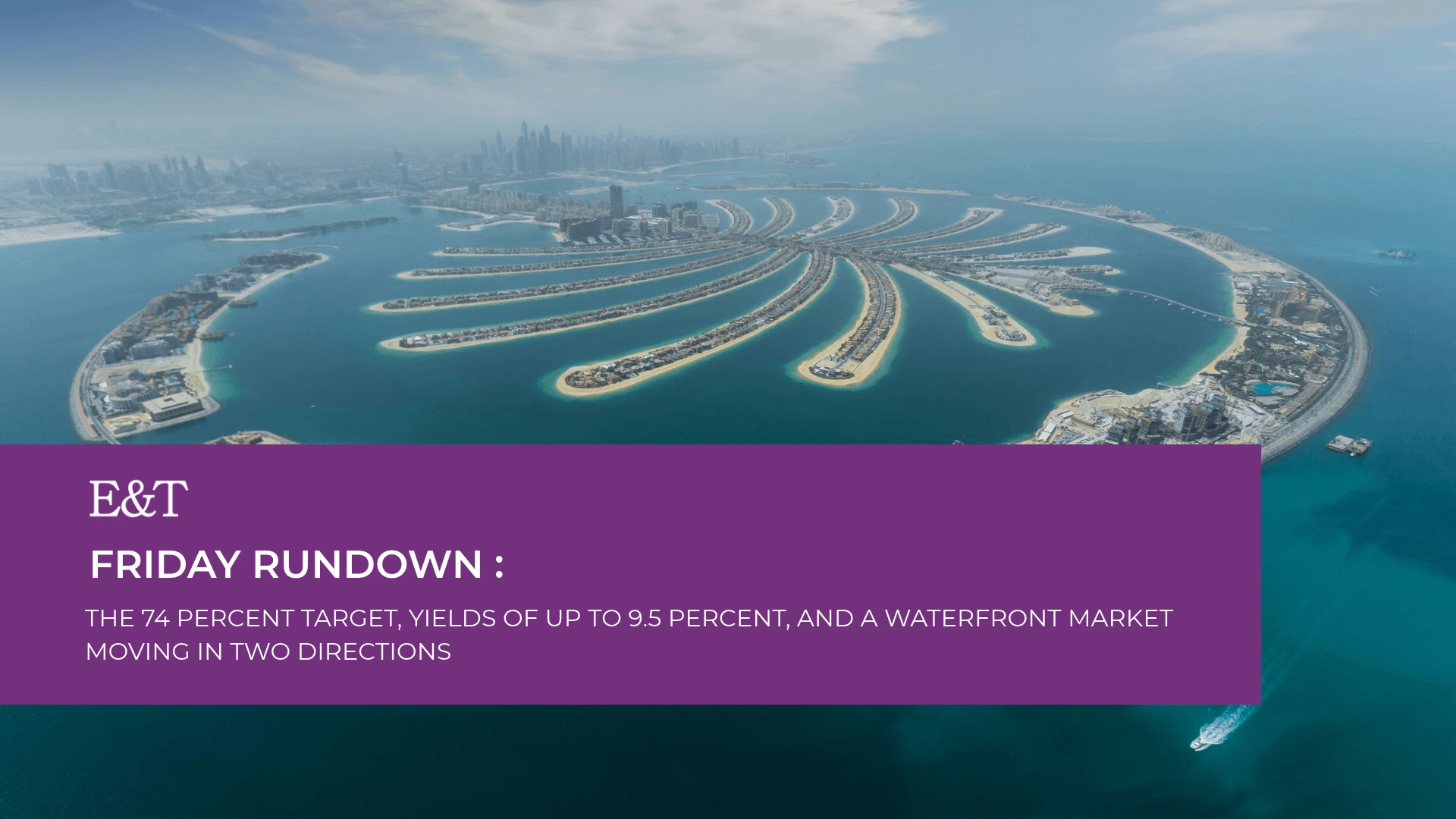

The 74 Percent Target, Yields of Up to 9.5 Percent, and a Waterfront Market Moving in Two Directions
This week in Dubai real estate.
The most useful number in Dubai property this week is not a sales total. It is 74 percent. That is the share of residents Dubai now plans to house around metro stations, up from 52 percent today, under an urban plan approved this week. None of the week’s headlines were records, but together they show where demand is being steered: fresh Q3 yield and asking price data, a waterfront reading that splits sharply by address, and early signs of institutional appetite for a dedicated Dubai fund.
Dubai Approves a Plan to Build Around the Metro
The Executive Council of Dubai approved the Urban Centres Development Plan this week, with a budget above AED 2 billion. It covers six main urban centres and 42 supporting sub centres, which together make up 12 percent of Dubai’s urban area. The plan aims to concentrate homes and jobs around public transport stations. Its stated goal is to lift property values across the targeted centres by AED 20 billion by 2040.
Two service targets sit underneath. The share of residents living around metro stations is planned to rise from 52 to 74 percent, and public services coverage from 74 to 85 percent. The Council also approved a Sustainable Population Planning Policy, which uses population forecasts to anticipate demand for infrastructure and services, in line with the D33 Economic Agenda.
For property, the direction matters more than the headline figure. Government policy is now explicitly steering growth toward transit connected communities. The coverage published this week did not name the individual centres, so buyers should wait for those locations before treating any specific community as a beneficiary.
Q3 Yields: The Highest Sit at the Affordable End
New Q3 data published on October 29 estimates gross rental yields of up to 9.5 percent for affordable apartments in selected communities. Average asking prices stayed broadly stable, with quarterly movement in asking prices per square foot generally below 3 percent across popular affordable and mid tier areas.
| Segment | Community | Estimated gross yield |
| Affordable apartments | Dubai Investments Park | 9.5% |
| Affordable apartments | Discovery Gardens | 8.5% |
| Affordable apartments | Remraam | 8.4% |
| Mid tier apartments | Living Legends | 7.5% |
| Mid tier apartments | Town Square | 7.4% |
| Luxury apartments | Al Sufouh | 7.1% |
| Mid tier villas | The Sustainable City | 6.1% |
| Luxury villas | Jumeirah Golf Estates and Tilal Al Ghaf | 5.5% each |
| Ultra luxury villas | Al Barari | 4.9% |
Source: Q3 2026 asking price and yield data published October 29. Yields are estimates built from advertised prices and rents, not completed transactions. Verify before publication.
On pricing, ultra luxury apartments on Palm Jumeirah rose 3.4 percent on the quarter to an average asking price of AED 3,490 per square foot. JVC averaged AED 1,419 per square foot at an estimated 7.1 percent yield, and Business Bay averaged AED 2,158. Asking rents softened in JVC, Business Bay and Arjan, with marginal corrections in Dubai Marina, Downtown Dubai and Meydan.
The same research surveyed more than 2,000 residents. Sixty percent of buyers were very confident or cautiously optimistic about the market over the next five years. Forty six percent expect prices to rise over the next 12 months and 34 percent expect them to hold. Nearly 45 percent of surveyed renters had considered buying instead of renting. Of those surveyed, 18 percent were actively comparing the options and 26 percent said they could not afford the down payment.
Waterfront Asking Prices Split by Address
September waterfront data compares advertised asking prices with September 2025. Emirate wide, the average asking price per sale listing rose 21.11 percent in Abu Dhabi to AED 4.3 million, 7.14 percent in Dubai to AED 5.7 million, and 6.18 percent in Sharjah to AED 3.7 million. Within Dubai the spread was much wider.
| Dubai location | Average asking price | Change year on year |
| The Crescent, Palm Jumeirah | AED 22.2m | Up 39.78% |
| Palm Jumeirah overall (4,870 listings) | AED 24.2m | Up 1.12% |
| Dubai Harbour | AED 9.1m | Up 3.52% |
| Dubai Islands (5,143 listings) | AED 5.0m | Up 5.5% |
| Dubai Marina (6,440 listings) | AED 4.7m | Unchanged |
| Emaar Beachfront | AED 5.0m | Down 3.77% |
| Palm Jebel Ali | AED 30.7m | Down 28.13% |
Source: September 2026 asking price data published October 28. These are advertised prices, not completed sales. Verify before publication.
The near 40 percent jump at The Crescent needs context. Averages across advertised listings move with the mix of homes on the market as well as with pricing, so a change in which units are listed can swing an average without a single price moving. The same caution applies to the 28 percent fall at Palm Jebel Ali, a community still under development. One figure is easier to read: the typical asking price on Palm Jumeirah is AED 9 million, four times the emirate wide typical figure of AED 2.25 million.
Capital Looks for a Dubai Vehicle
Dar Global said on Monday that its investment arm is considering a dedicated Dubai real estate fund. The arm operates from DIFC, is regulated by the Dubai Financial Services Authority, and targets sovereign investors, institutions and wealthy private clients. No fund size, launch date or acquisition targets have been disclosed, so this is intent rather than commitment. Separately, new analysis published this week put Dubai property investment at about USD 185 billion over the past 12 months, across 258,600 investments, up 29 percent in value year on year.
This Week’s Snapshot
| Metric | Figure | Context |
| Urban Centres Development Plan | Budget above AED 2bn | Target AED 20bn value uplift by 2040 |
| Residents living near metro stations | 52% to 74% | Plan target |
| Highest affordable apartment yield | 9.5% | Dubai Investments Park |
| Palm Jumeirah ultra luxury apartments | AED 3,490 per sq ft | Up 3.4% on the quarter |
| Dubai average asking price per listing | AED 5.7m | Up 7.14% year on year |
| Renters who considered buying | Nearly 45% | Survey of 2,000+ residents |
| Dubai property investment, trailing 12 months | About USD 185bn | 258,600 investments |
The Investor Takeaway
Three reads from this week. First, policy is picking its winners by proximity. A plan to lift the share of residents near metro stations from 52 to 74 percent favours transit connected communities over time, though the specific centres are still to be named. Second, the yield and asking price data describe a stable market rather than a falling or surging one. The strongest income sits at the affordable end, while the largest asking price swings sit on the waterfront, where averages are volatile and listing mix matters. Third, nearly half of surveyed renters have considered buying, and a quarter said the deposit is out of reach. For many of them that is a financing and planning question more than a market one.
Whether you are weighing a rental against a purchase, comparing yields across communities, or reviewing a waterfront asset against current asking prices, our team is available for a private consultation or complimentary valuation.
Contact us at info@edwardsandtowers.com or visit edwardsandtowers.com.

