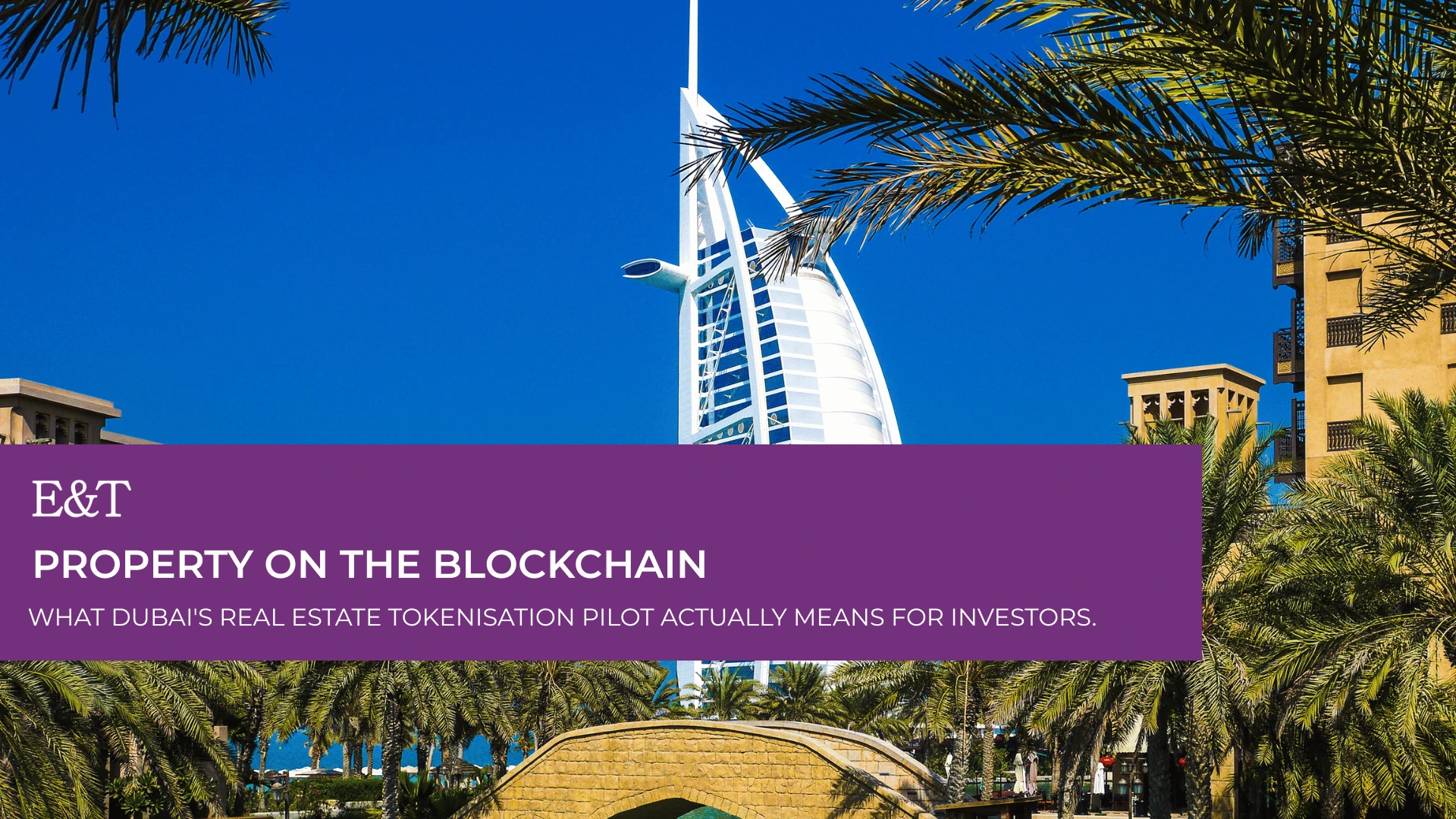

Property on the Blockchain: What Dubai’s Real Estate Tokenisation Pilot Actually Means for Investors.
The Dubai Land Department has launched a pilot integrating blockchain-based property titles directly into the land registry. For most investors, that sentence lands somewhere between technically interesting and practically irrelevant. It should not. The implications for how property is bought, sold, and held in Dubai are more substantial than the pilot’s quiet rollout might suggest.
What Tokenisation Actually Is
Tokenisation is the process of converting ownership rights in a physical asset, in this case real property, into digital tokens recorded on a blockchain. Each token represents a fractional share of the asset. Those tokens can, in principle, be bought, sold, and transferred with the speed and transparency of a financial security rather than the friction of a traditional property transaction.
In the context of real estate, this matters for two reasons. First, it reduces the minimum capital required to access property markets, opening investment to a significantly broader pool of participants. Second, it introduces a layer of liquidity to an asset class that has historically been illiquid by nature. You cannot sell a quarter of a two-bedroom apartment in Business Bay on a Tuesday afternoon. With tokenisation, that transaction becomes, at least theoretically, possible.
What the DLD Pilot Involves
The DLD’s blockchain title integration is a foundational step rather than a consumer-facing product. By anchoring ownership records on a distributed ledger, the registry gains a layer of immutability and auditability that traditional title systems do not offer in the same form. Transfers become faster. Verification becomes more transparent. The audit trail is embedded in the record itself rather than dependent on external documentation.
The pilot aligns directly with the D33 Economic Agenda’s ambition to position Dubai as a global hub for financial innovation. A property market that operates on verifiable, transferable digital titles is structurally more attractive to the international institutional capital that D33 is designed to attract.
Fractional Ownership: The Emerging Opportunity
The more immediately visible application for retail investors is fractional ownership, which is beginning to emerge across the UAE property market. The framework allows investors to hold a defined percentage of a property rather than the whole asset, with ownership, income, and capital appreciation rights proportional to the token holding.
| Min. Entry | Liquidity | Income Access | Regulatory Status |
| Full asset value | Low | Immediate on let | Established |
| 10-20% deposit | Low pre-completion | Post-completion | RERA regulated |
| To be defined | Potentially high | Pro-rata yield | Pilot phase (DLD) |
Note: Tokenised fractional ownership is in pilot phase. Regulatory frameworks are evolving. Investors should seek current legal guidance before committing capital.
What It Means in Practice Right Now
For the majority of investors transacting in Dubai today, tokenisation is a horizon story rather than an immediate operational reality. The DLD pilot is a proof-of-concept that establishes infrastructure. The consumer and commercial applications that sit on top of that infrastructure will take time to mature, regulate, and scale.
What it does signal is that Dubai is deliberately building the architecture for a more fluid, accessible, and internationally integrated property market. Investors who understand the direction of travel are better positioned to evaluate which assets, in which districts, are likely to benefit most from increased liquidity and a broadening international buyer base.
The combination of blockchain-anchored title records, fractional ownership frameworks, and the UAE’s existing advantages of zero property tax, full foreign ownership rights, and RERA-governed transaction transparency creates a compelling structural environment. The question is not whether this direction is credible. The DLD pilot confirms that it is. The question is the pace of adoption.
The Broader Context
Dubai’s total transaction value surpassed AED 500 billion across 186,000 sales by late 2025, overtaking the full-year figure for 2024. The market that tokenisation will eventually operate within is one of the most active property markets in the world by transaction volume. Average pricing of approximately AED 1,676 per square foot keeps the city accessible relative to comparable global hubs, while demographic growth,
corporate relocation activity, and the Golden Visa framework continue to support sustained end-user demand. Tokenisation does not change those fundamentals. It adds a layer of accessibility and liquidity on top of them. That combination, if the regulatory framework develops at pace, represents a meaningful expansion of who can participate in Dubai real estate and how.
If you want to understand how emerging ownership structures and market developments affect your investment strategy in Dubai, our team is available for a private portfolio consultation.
Contact us at info@edwardsandtowers.com or visit edwardsandtowers.com.